


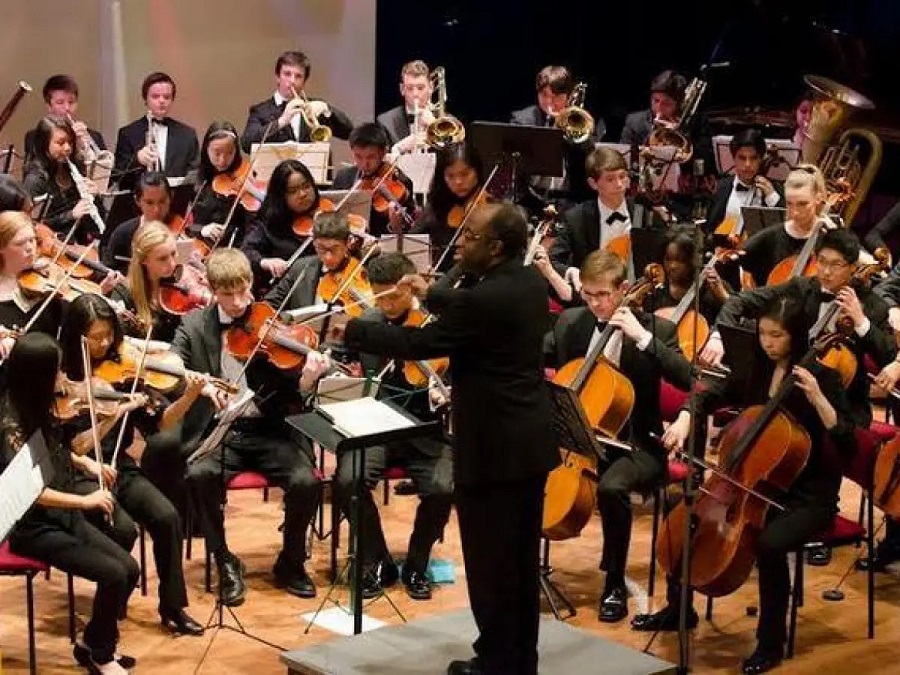
The Oakland Symphony’s performance at the Paramount Theatre on Friday, February 20, 2026, showcased a powerful blend of cultural expression and classical music, highlighting the diverse backgrounds of the composers featured in the program. Under the direction of conductor Kedrick Armstrong, the evening’s program, To These Shores, celebrated four composers—Chen Yi, Reena Esmail, Gustav Mahler, and Daniel Bernard Roumain—who each brought unique cultural influences into their classical music compositions.
The evening began with Chen Yi’s Introduction, Andante, and Allegro, which drew from Chinese folk music and Peking Opera. The symphony’s execution was impeccable, particularly the woodwind section, whose integration was seamless, producing a rich and unified sound. Despite some minor intonation issues in the second movement, the orchestra’s expressive delivery captured the evocative essence of Chen’s work, aided by Armstrong’s fine interpretation. The acoustics of the Paramount Theatre slightly diminished the strings and brass, but the orchestra’s performance remained impressive.
Next, the program shifted to Gustav Mahler’s Adagio from his Tenth Symphony. The orchestra brought an intimate and nuanced interpretation to Mahler’s sprawling movements, with the violins delivering passionate, legato themes supported by masterful low brass. While the transition into the scherzo section lost some momentum, the orchestra’s careful attention to detail during the concluding pages brought a sense of urgency and poignancy to the piece.
The concert’s grand finale featured the world premiere of America, To US, a violin concerto by Oakland Symphony Artist in Residence Daniel Bernard Roumain. Written for violinist Tracy Silverman, the concerto melded traditional violin with amplified electric sounds, pushing the boundaries of classical music. Silverman’s performance on the six-string electric violin was nothing short of extraordinary, blending the rich tradition of romantic violin playing with the raw, gritty energy of modern electronic music. Roumain’s composition, with its dramatic “Town Hall Cadenza,” introduced voices from the Oakland community—children and adults alike sharing their dreams and stories. This moment of community participation poignantly emphasized the connection between music and the world outside the concert hall, reinforcing the symphony’s commitment to inclusivity and the broader social message of hope.
The evening proved to be a striking example of the Oakland Symphony’s mission to bring classical music to life through diverse cultural voices, presenting a unique fusion of traditions and modern expressions. With the concert resonating deeply with both the performers and the audience, it was clear that Armstrong’s leadership and the symphony’s commitment to community engagement are instrumental in shaping Oakland’s cultural landscape.
